
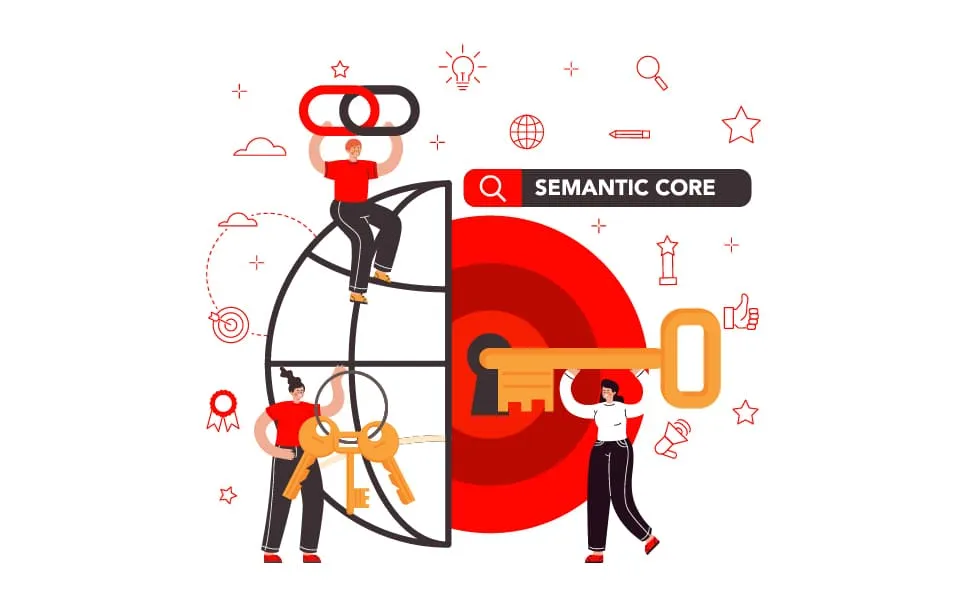
A semantic core is a structured list of search queries people should find you by, already mapped to the pages of your site. Building one means going from a set of ideas to a finished content plan: find the queries, pull search volumes, group them by meaning, and decide which page answers which cluster. Below is a working sequence with no filler and honest caveats about search volume.
Key points in 30 seconds
- A semantic core answers three questions: what people search for, how often, and which page to send them to.
- Keywords come from several sources at once: a single tool gives an incomplete picture.
- Search volume from free tools is approximate: zeros and ranges shouldn’t be taken literally.
- Clustering means grouping queries by meaning: one cluster = one page = one intent.
- The end result isn’t a keyword spreadsheet but a content plan with priorities mapped to URLs.
What a semantic core is and why you need one
The semantic core is the foundation of SEO and content marketing. Essentially, it’s a demand map: which queries people type, how many there are, with what intent, and which page they should logically land on. Without a core, content gets written at random: some topics duplicate each other, some popular queries end up with no page at all, and the budget for copy and links is wasted.
A good core answers three questions: what to target, how often it’s searched, and where to send the traffic. If even one answer is missing, the core is raw and not ready to work with. We moved the detailed breakdown of terms (search volume, intent, clustering) into a separate article on keyword semantics; here we’ll focus on the research process.

Keyword sources: where to get queries
A beginner’s mistake is building the core from a single tool. Each source sees demand from its own angle, so you combine them. Start with business logic (services, products, synonyms, what customers call you), then expand with tool data and competitor data.
| Source | What it gives you | What to watch for |
| Autocomplete and “Related searches” | Real user phrasing, long tail | Collected manually or with a scraper; lots of junk |
| Google Ads Keyword Planner / Wordstat | Seed queries and volume estimates | Volume is approximate: see the next section |
| Google Search Console | Queries you ALREADY show up for | Gold for an existing site: real demand, not hypothetical |
| Competitor analysis (Ahrefs, Serpstat) | Queries the niche leaders rank for | Shows gaps in your core |
| Generators (Answer the Public and similar) | Questions and long tail around a topic | Useful for FAQs and informational articles |
| People Also Ask / related questions | Adjacent intents and subtopics | A basis for subheadings and FAQ blocks |
For an existing site, open Search Console first: it shows which queries already bring people to you and where you’re just outside the top results. Those are the cheapest growth points. The rule is simple: the more independent sources you merge into one table, the fewer blind spots your core will have and the more accurate your demand map will be.
Pulling search volume and common pitfalls
Search volume is how many times a month a query is typed. Based on it, queries are split into high-, mid- and low-volume. But numbers from free sources need to be read critically.
| Type | Benchmark, impressions/month | Role in the core |
| High-volume | thousands and up | Broad and competitive; often for categories and hubs |
| Mid-volume | hundreds | The core’s main working layer |
| Low-volume | tens and single digits | Long tail; brings targeted traffic and conversions |
Pitfalls:
- Google Keyword Planner groups similar queries and shows ranges, not exact numbers. It often hides low-volume queries below a threshold and displays “0”.
- Wordstat shows “broad” volume by default, including all word forms and longer phrases that contain the query. The real volume of a phrase is checked in quotes and with the “!” operator.
- Zero isn’t a verdict. A query with zero volume in the planner can still bring targeted traffic: the tool simply didn’t count rare but high-purchase-intent phrasings.
- Seasonality and region skew averages. Check the 12-month trend and pull volume for the right geo.
Takeaway: don’t automatically throw out the zeros. Judge a query by intent and how close it is to revenue, not just by the number. We break down this threshold honestly using our own example in the article on keyword semantics.
Keyword clustering: grouping by meaning
Clustering is grouping queries that should be covered by a single page. The rule: one cluster = one page = one intent. If different queries lead to the same answer (“buy crowd links” and “order crowd marketing”), they’re one cluster. If the answers differ (“what is crowd marketing” and “buy crowd links”), the clusters are different: informational and commercial.
Methods:
- Manually by meaning: reliable for small cores, slow for large ones.
- By shared URLs in the top results (SERP clustering): queries are grouped if their top 10 results overlap. This is how clustering tools work.
The main risk of poor clustering is cannibalization: two pages compete for the same query and both lose rankings. That’s why clustering shouldn’t be left to automation alone: the tool groups by formal SERP overlap, and a human does the final check for meaning. What clustering is and how SERP overlap is calculated is covered in detail in the glossary article on keyword semantics.
From semantic core to content plan
A keyword table isn’t the result yet. You turn the core into a content plan in four steps.
- Assign an intent and page type to each cluster: commercial → service, category or product page; informational → blog article.
- Map the cluster to a URL: existing or new. One cluster shouldn’t be spread across several pages.
- Prioritize: intent (closer to revenue ranks higher) × search volume × realistic chance of reaching the top. Start with what pays off fastest.
- Build a publishing queue and content briefs. How to format the plan and how to brief a writer is covered in our articles on the content plan and SEO copywriting.
Commercial clusters are a separate layer. For them you plan not just copy but also an anchor plan for links: the core defines which phrases to use and which pages to point links to. That’s the direct bridge to your anchor list and link buying.
What building a semantic core costs and when to outsource it
You can realistically build a small core yourself (a landing page or a service site with 20–50 pages) in 1–2 days. For an online store with thousands of products and filters, manual research turns into a project lasting weeks, and that’s usually where people outsource it.
Market benchmarks: a core for a small site sits roughly in the lower price segment; for a large catalog it’s several times more expensive because of the volume and clustering. Prices are approximate and depend on the niche, volume and competition; we’ll calculate the exact cost for your project.
If you need a semantic core as the foundation of a strategy, with clustering, a content plan and anchor planning for links, not just to tick a box, take a look at our link building and SEO services or estimate the scope right away using our price list.
A finished semantic core is the map that both your content and your links follow. If you want a core together with a content plan and an anchor strategy for link buying, get a quote for your project or discuss the task with our team.