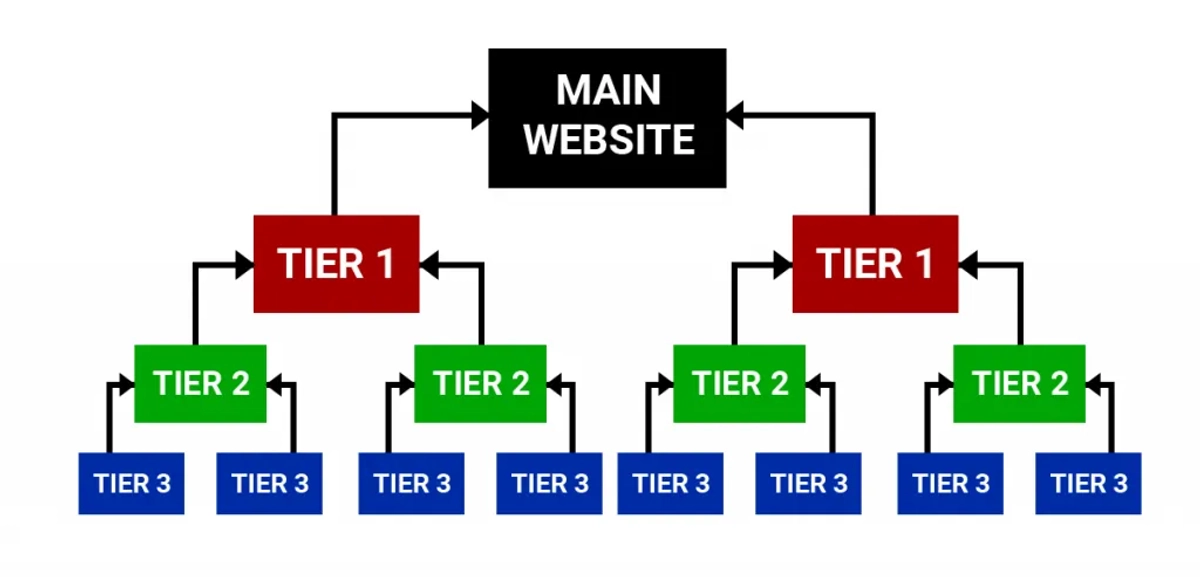

A tiered link scheme (link tiering) means building links not only to the site you’re promoting but also to the pages that already link to it. Tier 1 links point directly to your site. Tier 2 links point to tier 1 pages, and tier 3 links point to tier 2. The goal of the pyramid isn’t to “pump up volume” but to strengthen first-tier links and get them indexed faster.
Key points in 30 seconds
- Tier 1: direct links to your site; only quality donors belong here.
- Tier 2 and tier 3: supporting links that strengthen the first-tier links.
- The main purpose of the scheme is indexing and passing link equity, not artificial inflation.
- For most sites, a well-built tier 1 is enough; the pyramid is needed in competitive niches.
- A sloppy tier 2/3 (spam, automated posting, a cheap PBN) can drag your whole profile into a penalty.
What a tiered scheme or “link pyramid” is
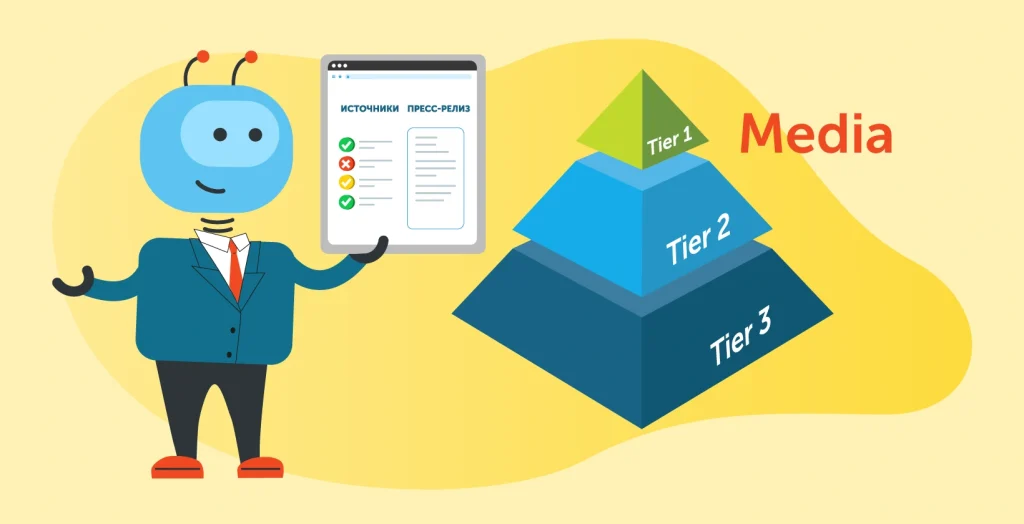
Tiered link building, also called a link pyramid, is a structure of several link levels where each lower level supports the one above it. It’s called a “pyramid” because of its shape: the top level is narrow (a few quality links pointing straight to the site), and the lower levels are wider (more basic links that point to links, not to the site itself).
An analogy makes it simpler. Tier 1 links are the “storefronts” Google sees next to your site and uses to judge its authority. Tier 2 and tier 3 are the “support”: they help those storefronts get indexed faster and build up their own weight, which then flows to your site.
How the tier 1 / tier 2 / tier 3 scheme works
| Tier | Where the links point | Typical platforms | Quality requirements | Purpose of the tier |
| Tier 1 | To your site | Outreach, guest posts, quality crowd links, niche donors | Highest: trust, topical relevance, real traffic | Pass weight and trust to the pages you’re promoting |
| Tier 2 | To tier 1 pages | Crowd links, profiles, article sites, social media | Medium: active sites without obvious spam | Get tier 1 indexed and strengthen it |
| Tier 3 | To tier 2 pages | Bulk placements, directories, bookmarks | Low, but not junk | Speed up tier 2 indexing |
Visually, it looks like an inverted funnel: your site at the top, a narrow row of tier 1 below it, a wider tier 2 further down, and the most numerous tier 3 at the base. The lower the tier, the simpler and cheaper the links, because their job is technical rather than “showing the site to Google.”
Why strengthen the links themselves at all
At first glance it seems odd to pay for links to links. But there are three concrete reasons.
- Indexing. A link Google hasn’t seen doesn’t work. This is especially true for articles and profiles on weak or new pages, which the crawler rarely reaches. Tier 2 “highlights” such a page and speeds up its indexing.
- Passing link equity. A tier 1 donor page gains weight from tier 2 and passes more of it to your site than an “empty” page with no inbound links would.
- Reviving static links. A link on a long-forgotten page looks dead to Google. A careful tier 2 adds activity signals to it.
When a pyramid makes sense and when it’s overkill
It makes sense when:
- the niche is highly competitive and tier 1 alone isn’t enough to catch up with the top;
- tier 1 links sit on weak or new pages and get indexed poorly;
- you need a buffer for riskier placements: they’re moved to tier 2 so that “gray” links don’t point directly at money pages.
It’s overkill when:
- the site is young and has only a dozen links so far: you first need a base of quality tier 1 links, there’s nothing to strengthen yet;
- the niche is white-hat or local, where crowd links and outreach are enough;
- you don’t have the resources to control the quality of the lower tiers: then the pyramid brings more risk than benefit.
The main rule: a pyramid is an amplifier, not a replacement for a solid first tier. Without a quality tier 1 there’s nothing to amplify, and no tier 2/3 will save a weak profile.
Risks of a sloppy setup
- Spam disguised as tier 1. If cheap automated posting points straight at the site, that’s no longer a pyramid but a direct route to a penalty.
- Footprints. Identical templates, anchors and platforms across all tiers give away the whole scheme; Google sees the pattern.
- Anchor over-optimization in lower tiers. Commercial anchors piled up in the lower tiers can “leak” through the signals to the site.
- Deindexing of lower tiers. If tier 2/3 drop out of the index, the boost is gone and the money is wasted.
A pyramid is part of a strategy, not a goal in itself
A tiered scheme only makes sense on top of a solid foundation. If you’re just starting out, it’s more logical to build a reliable first tier first; see the article on link building strategy from scratch and the cornerstone guide what is link building. And to get tier 1 links indexed faster (without that, the pyramid is pointless), read the breakdown on how to speed up link indexing.
Building a safe tiered scheme without footprints and junk platforms is a job for specialists. It’s part of our link building services, where tier 1 is built on real donors and the boost is added carefully and under control.
Not sure whether your project needs a pyramid or a quality tier 1 is enough? Describe your task and we’ll assess your link profile and propose a scheme for your niche and budget: discuss your project. Prices are approximate and depend on the niche, volume and competition; we’ll calculate the exact cost for your project.