
Donor metrics are estimates of a site’s authority and “cleanliness” calculated by third-party SEO tools (Ahrefs, Moz, Majestic) to quickly judge whether it’s worth placing a link on that site. The key ones are Domain Rating (DR), Domain Authority (DA), Trust Flow and domain spam score. The main point up front: Google itself calculates none of these metrics. They are estimates from independent services, so you can’t judge a donor by a single number.
Key points in 30 seconds
- DR (Ahrefs) and DA (Moz) estimate the strength of a link profile on a 0–100 scale.
- Trust Flow (Majestic) measures the quality of linking sites, not their number.
- Spam score (Spam Score in Moz) is the likelihood that a site resembles sites Google has already penalized.
- None of these metrics belongs to Google, and all of them can be inflated, so look at the combination.
- When choosing a donor, live organic traffic and topic matter more than a nice DR.
What Domain Rating (DR) is and who calculates it
Domain Rating is an Ahrefs metric on a scale of 0 to 100 that shows the strength of a domain’s link profile: how many other sites link to it and how authoritative they are themselves. The scale is logarithmic: raising DR from 20 to 30 is much easier than from 70 to 80.
DR only accounts for links. It knows nothing about traffic, content quality or the site’s topic. So a domain can have a high DR and still be a useless donor, for example a PBN or a site with an inflated backlink count. Use DR as a first rough filter, not as a verdict.

What Domain Authority (DA) is
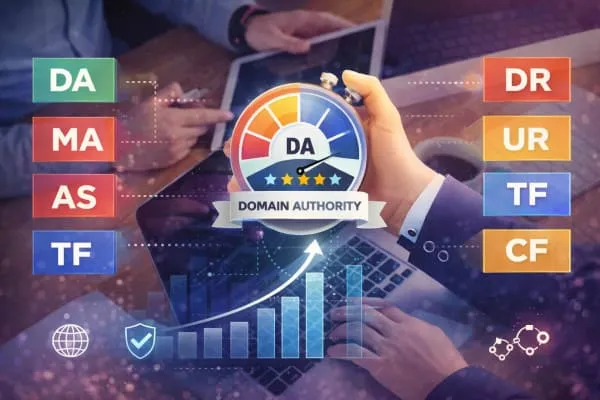
Domain Authority is a similar metric from Moz, also on a 0–100 scale. It predicts how well a domain is likely to rank in search and is calculated by a machine learning model based on link data. DA is a comparative metric: it only makes sense when comparing sites against each other, not as an absolute “quality score.”
DA is recalculated periodically, so the number can change without any action on your part. Like DR, it is not a Google factor but an external estimate. A new site almost always has a low DA. That is normal and by itself doesn’t make it a bad donor.
Trust Flow and Citation Flow (Majestic)
Trust Flow is a Majestic metric (0–100) that measures trust rather than strength: how close a site is, in link terms, to known trusted “seed” sites. Alongside it is Citation Flow, which reflects the number and “influence” of links regardless of their quality.
The key to reading these metrics is the Trust Flow to Citation Flow ratio. If Citation Flow is high and Trust Flow is low, the site has many links of questionable quality, a typical sign of a spammy or inflated site. A healthy ratio is one where Trust Flow doesn’t lag far behind Citation Flow. Topical Trust Flow is also useful on its own: it shows in which topics the site is trusted, which helps you pick a relevant donor.
Domain spam score (Spam Score)
Spam score is a risk estimate, not proof of a penalty. The best-known indicator is Moz’s Spam Score: it is now a percentage (1–100%) representing the share of sites with similar characteristics that were penalized by Google. The higher the percentage, the more signals the site shares with penalized sites: thin content, no contact details, over-optimized anchors, a large number of outbound links and so on.
Other tools have similar spam indicators. It’s important to understand that a high spam score is a signal to look closer, not an automatic ban. Sometimes a normal site gets a high score because of formal signals. And the other way around, a low spam score doesn’t guarantee the donor is good.
| Metric | Who calculates it | Scale | What it shows | Weak spot |
| Domain Rating (DR) | Ahrefs | 0–100 | Link profile strength | Ignores traffic and topic |
| Domain Authority (DA) | Moz | 0–100 | Predicted ranking ability | Comparative, “drifts” on recalculation |
| Trust Flow | Majestic | 0–100 | Quality of linking sites | Must be read together with Citation Flow |
| Spam score (Spam Score) | Moz and others | 1–100% | Risk of resembling penalized sites | A signal, not a verdict |
Why you can’t rely on a single metric
All the metrics above have one thing in common: they are calculated not by Google but by third-party services using their own models and their own link databases. Three conclusions follow. First, different services will give the same site different scores. Second, any of these metrics can be inflated: PBN owners deliberately “pump up” DR and DA to sell links at a higher price. Third, a nice number says nothing about live traffic: a domain with DR 60 and zero visitors is almost certainly dead or artificial.
That’s why donor metrics only work in combination and only together with checking real indicators: organic traffic, topical relevance and a reasonable number of outbound links. We go through a detailed checklist in a separate article on how to check site trust and choose a donor.
Thresholds for choosing a donor
There are no hard “correct” numbers: thresholds depend on the niche and competition. But as a guideline you can use these ranges:
- DR / DA: from ~20–30 in niche topics; this is an entry filter, not the main criterion.
- Trust Flow: ideally 10–15 or higher, and not far behind Citation Flow.
- Spam score (Spam Score): below ~30%; the lower, the better.
- Mandatory beyond the metrics: live organic traffic (per Ahrefs/Semrush), a relevant topic, a reasonable number of outbound links and real page indexing.
Prices and thresholds are approximate and depend on the niche, volume and competition; we will work out exact donor selection criteria for your project.
Manually vetting donors against all these metrics is exactly what goes into a quality placement. If you don’t want to deal with the numbers yourself, you can buy crowd links on already vetted sites or order full-service link building on a turnkey basis. To understand the big picture of off-page SEO, start with our core guide on what link building is; it’s also worth learning what a link profile is, since spam score is part of it.
Not sure which sites suit your website? We vet donors manually by DR, DA, Trust Flow and spam score, cutting out inflated and dead sites: send a request and we will pick sites for your niche.