
E-E-A-T (Experience, Expertise, Authoritativeness, Trust) is a set of criteria from Google’s guidelines for quality raters, used to manually assess the quality of content and its author. YMYL (Your Money or Your Life) covers topics that affect a person’s health, finances, safety and well-being; Google holds such pages to the strictest E-E-A-T standards. One thing to understand right away: E-E-A-T is not a direct ranking factor or a “score” inside the algorithm but a quality framework that algorithms approximate through many signals.
Key points in 30 seconds
- E-E-A-T stands for Experience, Expertise, Authoritativeness, Trust; Google added the Experience letter in December 2022.
- Trust is the center of the model: the other three components support it, and high E-E-A-T is impossible without trust.
- It is a concept from the guidelines for human quality raters (Search Quality Rater Guidelines), not a switch in the algorithm.
- YMYL covers topics on health, money, law and safety; for these the bar for expertise is at its highest.
- Google evaluates not just the text but also the author and the whole site: who wrote it, what sources it cites and who stands behind it.
What E-E-A-T means in simple terms
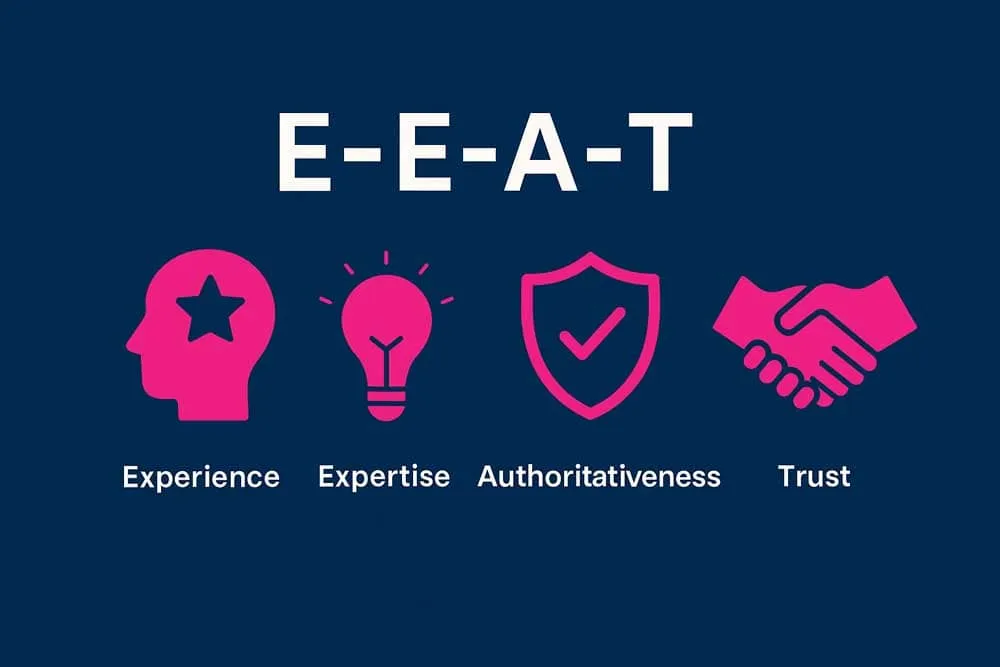
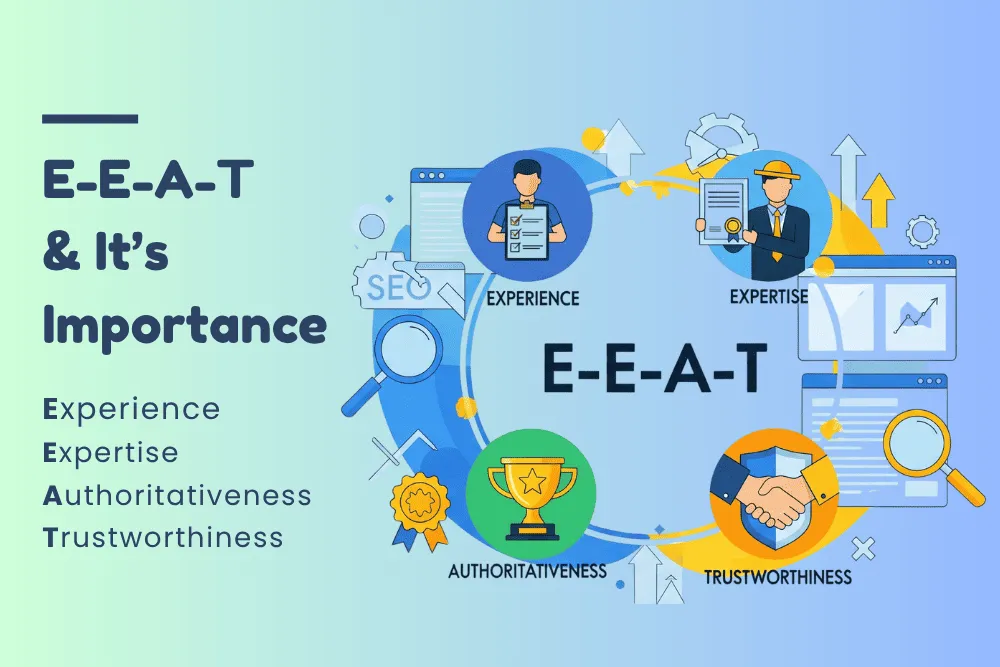
The acronym has four components, and each answers its own question:
- Experience. Does the author have first-hand practical experience with the topic? A review of a drug by a doctor who has prescribed it is worth more than a secondhand retelling of the label.
- Expertise. The depth and accuracy of the author’s knowledge: do they understand the subject at a professional level?
- Authoritativeness. Recognition of the author and the site in the industry: mentions, links, reputation, citations by other resources.
- Trust. How far the site can be trusted: security, factual accuracy, transparency. Google calls Trust the most important element of the model.
What YMYL is and why the requirements are higher
YMYL (Your Money or Your Life) covers topics where a mistake in the content can actually harm a person: their health, wallet, safety or rights. Google includes medicine, finance and investing, legal matters, major purchases, citizenship and safety issues, and important news. The logic is simple: bad advice about medication or taxes costs far more than a mistake in an article about a hobby. That is why the search engine applies the strictest checks of expertise and trust to YMYL pages, and weak E-E-A-T hits such sites the hardest.
What Google actually checks (and what is a myth)
To be honest: there is no separate “E-E-A-T score” inside the algorithm. Raters assign scores manually so Google can calibrate its algorithms, but these scores don’t affect rankings directly. The algorithm approximates E-E-A-T through indirect signals:
- the online reputation of the author and the brand: what other resources write about them;
- the link profile and mentions from authoritative platforms;
- accuracy, completeness and freshness of facts;
- technical trust signals: HTTPS, contact details, company details, a privacy policy, real reviews.
The biggest myth: “add an author box with a photo and you get E-E-A-T”. In reality the signals have to be genuine: a fake expert or bought mentions don’t create trust and are more likely to hurt you when checked.
How to show expertise: authors, sources, updates
E-E-A-T isn’t “turned on” with a single setting. It takes systematic work on content and reputation. Below are the components and specific actions for each.
| Component | What it is | How to strengthen it |
| Authors | Who wrote it and their qualifications | Real authorship, a bio showing experience, an “About the author” page, links to profiles and publications |
| Sources | What the facts are based on | Links to studies, official documents and statistics; figures with their sources |
| Updates | How current the material is | Publication and revision dates, regular updates, especially for fast-changing topics |
| Transparency | Trust in the site as a whole | Contacts, “About us”, company details, policies, moderated reviews |
A separate note on authorship: for YMYL topics, it is important that the material is written or reviewed by a qualified specialist and that their credentials are visible to both readers and search engines. This is part of what is called content authorship in SEO.
E-E-A-T for medicine and finance
YMYL niches are where the requirements are enforced most strictly. In medicine, Google expects content from doctors or with medical review, with links to research and no promises of a “guaranteed cure”. In finance, it expects correct calculations, disclaimers and, where needed, information about licenses and risks. For example, in the article on SEO for dental clinics we look at how a clinic can show the author’s expertise and gather local trust signals; similar logic applies in the article on SEO for legal services.
The role of links and external signals
Authoritativeness is largely built outside your site, by who links to you and mentions you. Links and brand mentions from authoritative niche platforms remain one of the main external signals of authority, and for AI engines they are also a way into the set of cited sources. Quality matters here, not quantity: one link from a relevant industry article carries more weight than dozens of random ones. How to build such a profile systematically is covered in the core article on link building.
Want to strengthen your site’s authority with natural links and mentions from niche platforms? Let’s discuss your project, and we’ll propose a strategy for your niche: link building services. For sensitive YMYL niches we’ll pick donors that build trust rather than undermine it, for example in the dental niche.