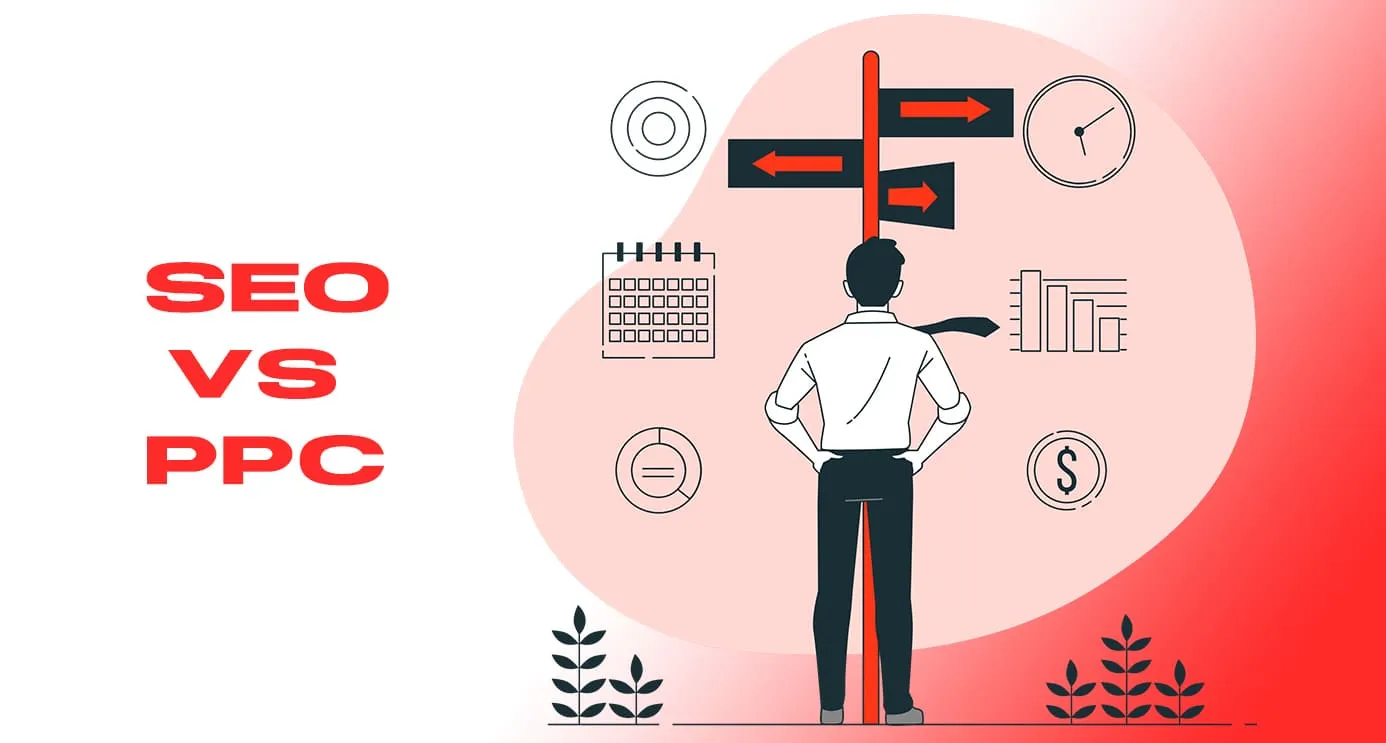

Over a one-year horizon, SEO and PPC have different economics. PPC advertising brings customers from day one, but every lead costs roughly the same the whole time and disappears as soon as the budget runs out. SEO starts slower: the first results come in 3–6 months, but the cost per lead drops over time, and traffic stays after you stop investing. That’s why for most businesses the right answer is not “either/or” but a combination of the two channels.
Key points in 30 seconds
- PPC delivers traffic immediately, but the cost per lead stays flat all year and drops to zero results along with the budget.
- SEO takes 3–6 months to ramp up, then the cost per lead falls and the asset (traffic) remains.
- Over a year, SEO more often wins on cost per lead in moderately competitive niches.
- PPC is the better deal for a fast start, testing hypotheses, seasonal peaks, and hyper-competitive niches.
- For most businesses the best setup is a combination: PPC covers the launch and immediate demand, SEO lowers acquisition cost over the long run.
The main difference: how cost per lead is formed
PPC is rented traffic. You pay for every click, and the cost per click barely depends on whether it’s your first month or your twelfth. Turn off the budget and the flow of customers stops the same day.
SEO is an asset. You invest once in content, links, and technical optimization, and the page then brings in customers for months. As rankings and traffic grow, the cost of each lead goes down: the costs are already spent, while the flow keeps growing.
Hence the difference in the curves: with PPC, cost per lead is an almost flat line; with SEO, it slopes downward. Over a long horizon, that gap is what decides the matter.
SEO vs PPC compared on key parameters
| Parameter | PPC advertising | SEO |
| Speed of first leads | From day one | In 3–6 months |
| Cost per lead over time | Stable | Decreasing |
| What remains after you stop | Nothing | Traffic and rankings keep working |
| Predictability | High | Medium, depends on algorithms |
| Spending control | Flexible: on / off | Inertial |
| Main expenses | Click budget + management | Content + links + technical work |
| Best for | Immediate demand, tests, promotions | A long, steady flow |
A calculation with real numbers
Take an online store in a moderately competitive niche. The figures are hypothetical (in USD), but the proportions are close to reality.
PPC
- Click ≈ $0.50, click-to-lead conversion ≈ 3% → one lead ≈ $17.
- A budget of $1,000/month ≈ 2,000 clicks ≈ 60 leads per month.
- Per year: $12,000 spent, about 720 leads; cost per lead is ~$17 in both January and December.
SEO
- Investment ≈ $800/month (content, links and crowd links, technical work) ≈ $9,600 per year.
- Months 1–3: almost no traffic, leads ≈ 0.
- Months 4–6: growth, 20–40 leads per month.
- Months 7–12: 80–150 leads per month.
- Total for the year: about 600 leads, an average cost per lead of ~$16 for the year, almost the same as PPC.
The difference lies elsewhere: by December, the current cost per lead from SEO is already ~$6–7, and in January of the next year traffic keeps coming without new spending on clicks. In the first year the channels are comparable on cost per lead, but their trajectories diverge: PPC holds the price, while SEO lowers it and leaves you with an asset.
When PPC is the better deal
- You need leads here and now: a launch, a cash gap, urgent workload.
- You need to test a niche, an offer, or a landing page before investing in SEO.
- Short promotions, sales, seasonal demand peaks.
- Hyper-competitive or “hot” queries where the organic top is taken by aggregators.
- A young site with no history, while SEO is still ramping up.
A simple example. A new dental clinic opens in a residential neighborhood. The site is two months old and doesn’t show up in organic search yet, but the chairs need to be filled now. PPC targeted at a few kilometers around the clinic will bring the first patients within a week. But SEO should be launched in parallel, otherwise the clinic will stay dependent on its ad budget.
When SEO wins
- You have a horizon of 6–12+ months and the goal is to lower acquisition cost.
- The topic has steady informational and commercial demand.
- Niches where PPC clicks are expensive (legal, medical, B2B): organic pays off faster.
- You need an asset, not a rental: traffic that stays after the budget stops.
You can estimate this on a napkin. Say a click for your query costs 40 UAH and you need 1,500 visits a month. That’s 60,000 UAH every month, and the flow stops the same day the budget runs out. SEO for the same queries will cost about the same or more for the first six months. But a year later, the cost per visitor is several times lower, and the traffic doesn’t disappear after the last payment.
Bottom line: combine, don’t choose
For most businesses, pitting the channels against each other makes no sense. The working setup: PPC at the start covers immediate demand and gives you data on which queries convert, while SEO running in parallel gradually takes over that same traffic and lowers acquisition cost. After a year you have both a flow of leads and an asset that keeps working.
The foundation of SEO results is the link profile and content. You can estimate how many links and how much budget your project needs in the pricing section, and the safest way to grow your link profile is to buy crowd links.
Further reading: how the budget for reaching the top is calculated in how much it costs to rank a site in the top; how to evaluate a channel’s return in how to calculate SEO ROI; and for the basics of working with links, start with what is link building.
What it costs: guidelines
- PPC: an ad budget from $500/month + management at $150–400/month.
- SEO: a full package from $600–1,500/month depending on the niche and competition.
Prices are approximate and depend on the niche, scope, and competition. We’ll calculate the exact cost for your project.
Not sure what to choose for your budget and timeline? Let’s discuss your project and work out a channel mix for your niche: leave a request and get a cost estimate.