
AI Overviews are the AI-generated answer block at the very top of Google’s search results: it synthesizes a ready-made answer from several sources right on the results page. For sites, this means some users get what they need without clicking through, and organic CTR for informational queries goes down. Below we look at what the data shows, which queries are affected most, and whose traffic dropped. This article is the diagnosis; how exactly to prepare content for AI answers is covered in a separate piece on GEO optimization.
Key points in 30 seconds
- AI Overviews cut clicks on informational queries: the user sees a ready answer right in the SERP.
- Question-type and definitional queries (what is, how to, why) dropped the most; commercial and transactional ones are less affected.
- By various estimates, organic CTR for affected queries falls by tens of percent, and the first position loses part of its clicks.
- Traffic doesn’t vanish completely, it gets redistributed: branded demand, inclusion in AI answers, and transactional pages become more valuable.
- The “treatment” (how to get into AI answers) is in our GEO article; here we cover the diagnosis itself.
What AI Overviews are and why they change the rules
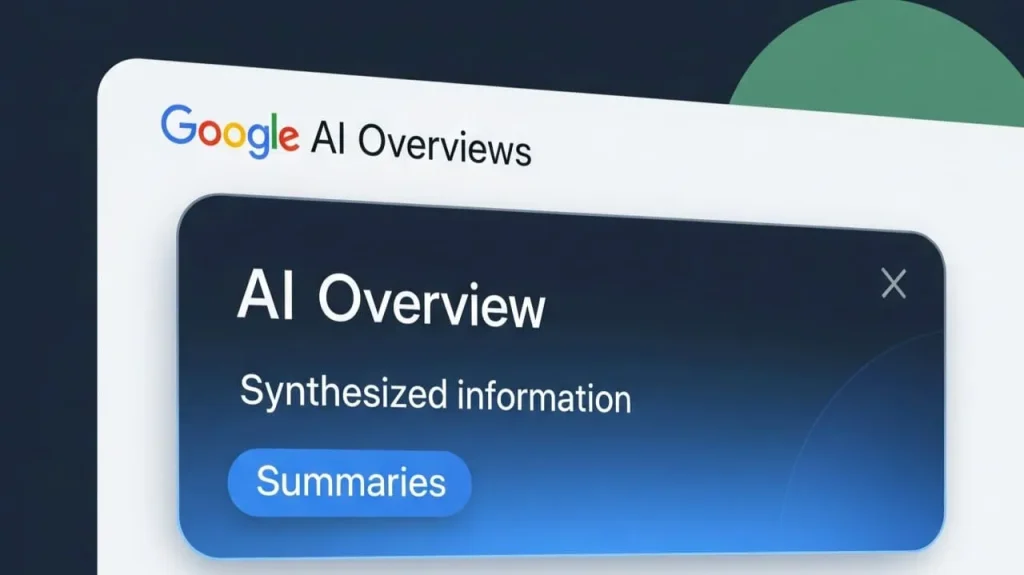
AI Overviews (formerly SGE, Search Generative Experience) are an AI-generated overview at the top of the search results. Unlike a classic featured snippet that quotes one source, AI Overviews synthesize an answer from several pages and often fully satisfy the user’s query. With links to sources, but with little need to click.
Hence the main effect: a growing share of zero-click searches, where the search ends but no visit to a site follows. The block sits above the organic results, so even the first organic listing ends up lower on the page than before and gets less attention.
What happens to traffic: CTR data
Exact figures depend on the niche, country, and measurement method, but every study points in the same direction. An AI Overview above the results pushes organic listings down and lowers their click-through rate. Based on observations from SEO platforms and agencies, the CTR drop for affected informational queries is estimated at roughly 15–20% to 30–40% and higher, strongest where the answer fits entirely in the AI block.
At the same time, the share of zero-click queries is growing: a large portion of searches now end without a visit to any site. It’s important to understand that impressions in your reports may hold at the previous level or even grow while clicks fall. In other words, it’s the CTR that drops, and the old logic of “you have a ranking, so you have traffic” needs rethinking.
| Query type | AI Overviews frequency | Impact on traffic |
| Informational (“what is”, “how to”, “why”) | Very high | Sharp CTR drop, many zero-click searches |
| Definitions and quick facts | High | The answer is read in the SERP, a click is barely needed |
| YMYL: medicine, finance, law | Medium, cautious | The block appears but with disclaimers; some clicks remain |
| Commercial (“buy”, “price”, “order”) | Low to medium | Weak impact: the user goes on to compare and buy |
| Navigational and branded | Very low | Practically unaffected |
Which queries are affected the most
The impact isn’t evenly distributed. Informational and definitional queries lose the most: those where the answer is short and unambiguous, and the AI gives it in full. Single-fact queries (exchange rates, the meaning of a term, a simple instruction) go almost entirely to zero-click.
- Most affected: informational and question-type queries, definitions, simple how-tos.
- Moderately: YMYL topics (medicine, finance, law): Google is more cautious here and more often leaves clicks to authoritative sources.
- Slightly: commercial and transactional queries: the user still needs to compare, choose, and buy.
- Almost unaffected: navigational and branded queries.
Whose traffic dropped and whose didn’t
Content and reference projects, media, and blogs that live on informational traffic were hit hardest, especially those whose content repeats common knowledge and is easy for AI to “collapse” into one paragraph. Thin articles about nothing, written only to target a high-volume keyword, dropped the most sharply.
Brands with their own expertise, unique data, and strong direct demand proved more resilient: they’re more often picked as AI Overviews sources, and they get branded clicks that AI doesn’t intercept. Online stores and service sites are barely affected on commercial queries; they mostly lose blog and informational traffic. The conclusion is simple: the closer a page is to the money and the more unique its value, the better protected it is.
Do backlinks affect inclusion in AI Overviews
Google doesn’t declare a direct, separate “AI ranking”. But AI Overviews are built on the same index and the same authority signals as regular search results. That’s why trusted pages with a quality link profile, mentions, and a recognizable brand are more likely to become sources in AI answers. We look at this connection in more detail in the article on whether backlinks affect rankings.
The practical takeaway: links aren’t “dying”, their role is changing. Now they’re also a signal of “who to trust as a source”. Real mentions on forums and in discussions (crowd marketing) build brand recognition, which models take into account, while systematic link building raises overall domain authority. We’ve collected the basic theory of how backlinks work in our pillar guide what is link building.
Forecasts: what to expect next
No fortune-telling, just observed trends: AI Overviews will expand to new queries, languages, and markets, and the share of zero-click searches on informational topics will grow. Value will keep shifting toward four things: branded demand, unique expert content, transactional pages, and presence in the AI answers themselves.
What this means in practice: part of the purely informational traffic can’t be won back, because AI has taken it. Instead, you can redistribute effort toward pages and queries closer to a conversion and work on becoming a source that AI cites. For how algorithms are responding in general, see our timeline of Google updates.
What to do: in brief
This article is a diagnosis, so the “treatment” here is in brief, and the detailed checklist is in our GEO piece. A minimal response plan:
- Rebuild your analytics: separate affected informational queries from commercial ones, and track not just clicks but impressions and branded demand.
- Strengthen transactional and commercial pages: their traffic is more resilient to AI Overviews.
- Build brand recognition and domain authority through mentions and quality backlinks so you become a source for AI.
- Prepare content for AI citations: we explain exactly how in our GEO article.
Want to estimate how much of your site’s informational traffic is at risk from AI Overviews and strengthen your rankings with authoritative links and mentions? Discuss your project with our team on the link building services page. We’ll work out the exact strategy and cost for your niche.