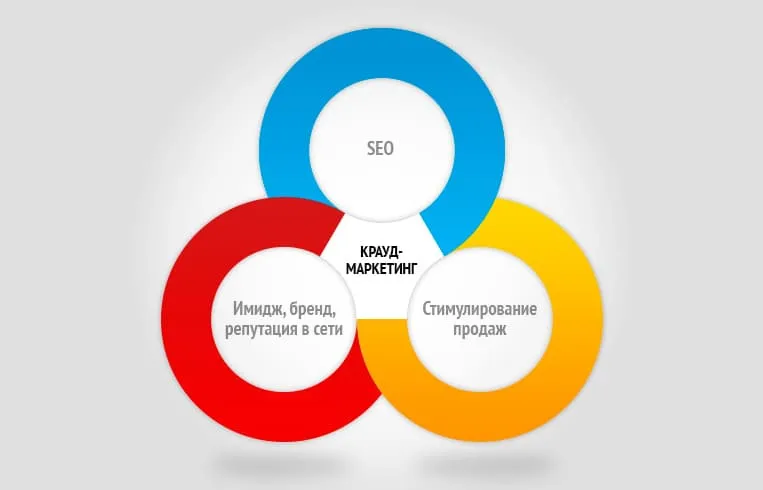

Crowd marketing is promoting a website, brand or product through natural mentions and recommendations in live discussions: on forums, in comments under articles, in niche communities, on review sites and Q&A platforms. Put simply, people talk about you where your audience already hangs out, not in an ad slot but in a conversation between real people. For SEO, crowd marketing solves two problems at once: it brings interested traffic to the site and builds a natural link profile through links from active platforms.
Key points in 30 seconds
- Crowd marketing means mentions and links in real discussions, not in directories, link marketplaces or site footers.
- Double benefit: clicks from interested people plus natural diversification of your link profile.
- The method works when the comment is useful to the reader and relevant to the thread.
- Crowd links do NOT replace a full link building strategy and are useless in niches with no active platforms.
- Spam with keyword anchors hurts; well-done crowd marketing is almost indistinguishable from organic discussion.
What crowd marketing is, in plain words
The term comes from the word “crowd”. The idea is that promotion happens through discussion participants, and the brand becomes part of the audience’s live conversation. Placement formats vary: forum replies, comments under articles and videos, messages in niche chats and groups, reviews on review sites, answers on Q&A platforms.
Unlike direct advertising, crowd marketing doesn’t shout “buy from us”. A good crowd comment first solves the person’s problem and then adds a link or brand mention as a relevant addition. So nobody treats it as an ad: not readers, not moderators, not search engines.


Crowd marketing, crowd links and forum links: what’s the difference
These terms get mixed up all the time, even in client briefs. Crowd marketing is the whole strategy of a brand’s presence in discussions, including mentions without a link. Crowd links are the concrete result of that work: a hyperlink to your site inside a comment or reply. Forum links are the most common type of crowd link, placed specifically on forums, where the thread, its author and the replies stay in the index for years. For SEO, the forum segment matters most: unlike comments on social networks, forum pages are open to crawling, have history and a topical structure of sections.
How crowd marketing works: why a live discussion beats a directory
Search engines stopped evaluating the mere fact of a link long ago; they look at its context. And here the gap between a directory and a live discussion is huge.
A directory link sits in a row of hundreds of identical ones, surrounded by boilerplate text, and means nothing to the reader. Think of a laundromat corkboard: everyone pins something up, nobody reads any of it. Such platforms share a common footprint that Google easily uses to detect artificial placements. A link in a live discussion, on the other hand, is surrounded by unique text, sits in a topical context, often uses a naked URL or branded anchor and, most importantly, real people click it.
Those clicks send behavioral signals that a directory never produces. Even if the link is nofollow, it brings targeted traffic and helps shape a natural profile. That is why one quality mention in a relevant discussion is worth more than a dozen directory links.
What happens to a crowd link inside Google
Links are still part of the algorithm: in its list of ranking systems, Google explicitly names “Link analysis systems and PageRank” and notes that PageRank has been one of its core systems since Search launched. The path of a crowd link looks like this: a crawler fetches the forum page, sees the <a href> tag and its rel attribute, evaluates the topic of the thread and the surrounding text, and then decides whether to count the link and how much weight to give it. That’s why the discussion page itself has to be indexable, and the link has to be a normal HTML link rather than a JavaScript button.
The connection between links and traffic shows up in large-scale data too. In a study by Ahrefs, 96.55% of pages get no traffic from Google, and there is a clear correlation between the number of referring domains and a page’s traffic. Correlation isn’t causation, but it shows that pages without a single external link rarely attract a meaningful audience.
Crowd marketing for brand and AI answer mentions
The other half of crowd marketing’s value has nothing to do with links. Generative systems (AI Overviews, chatbots with search) build answers from what people write about brands on open pages, and forums are among those sources. Researchers from Princeton and other universities showed in GEO: Generative Engine Optimization that adding sources, quotations and statistics increases content visibility in generative answers by up to ~40%. The practical takeaway for crowd marketing: a comment with specifics (numbers, comparisons, the brand name in a normal sentence) is more likely to be “picked up” than an empty “highly recommend”. Learn more in our article on generative engine optimization.
The rel=”ugc” attribute: what Google says about forum links
Google has a recommendation specifically for crowd content. Its help page on qualifying outbound links says site owners should use rel=”ugc” (user-generated content) for links in comments and forum posts, rel=”sponsored” for ads and paid placements, and rel=”nofollow” when a site doesn’t want to be associated with the linked page.
Here’s the detail people tend to forget: since 2019, Google treats sponsored, ugc and nofollow as hints rather than strict directives. So a link with rel=”ugc” or nofollow isn’t automatically “crossed out”: the search engine decides on its own whether to take it into account. That’s why crowd links with attributes aren’t useless, although you shouldn’t expect the same effect from them as from a strong, relevant dofollow link.
Dofollow or nofollow: what forums actually use
A common belief is that “everything on forums is nofollow”. Our numbers show a more nuanced picture. According to our check of 16.5k forums in October 2026, among the 2,765 forums where external links appear in threads at all, the split looks like this:
| Link type in threads | Share of forums | What it means for crowd marketing |
| Dofollow | 49% | The link can pass weight; these platforms are the most valuable for SEO, so they’re worth protecting from spam |
| Nofollow / ugc | 32% | A hint for Google; works for traffic, brand and a natural-looking profile |
| Mixed | 10% | Depends on the section, account status or post age |
| Via redirect | 8% | The link goes through the forum’s internal script; the weakest option for SEO, but clicks still work |
The remaining ~1% couldn’t be classified with certainty. The takeaway: a healthy crowd profile naturally ends up mixed, and that’s a good thing. A profile where 100% of links are dofollow with identical anchors looks artificial; one that has dofollow, ugc and naked-URL mentions looks natural. Read more about the attribute balance in our article on dofollow vs nofollow.
From our practice
We checked 16,533 forums, and 14,869 of them (90%) responded. But a “live server” doesn’t mean a “usable platform”. Among the 8,508 forums where we could inspect threads, 68% had no external links at all in the threads we checked: moderators either delete them or don’t let them through. And of the 7,872 forums with a visible date of the latest post, only 58% had new posts in the last 3 months. That’s why we work with a small, curated part of our database instead of “running” a site through every address we found: platform selection, not volume, is what determines the result.
Why you need crowd links
- Profile diversification. A healthy link profile isn’t made of strong dofollow links alone; crowd links add natural proportions of nofollow and non-keyword anchors.
- Targeted traffic. Active platforms send people who need a solution right now: they are closer to buying than a random visitor.
- Faster indexing and link boosting. Crowd links are often used as tier 2: to power up stronger links and speed up their indexing.
- Brand signals. Mentions of the company name in discussions build recognition, which both search engines and AI engines take into account more and more.
Crowd links compared with other link types
Crowd links don’t compete with other formats; they fill their own slot in the profile. To see where they fit, it helps to compare the main link types on key parameters.
| Link type | Where it sits | SEO strength | Risk | Main role |
| Crowd / forum | A reply in a live thread | Low to medium | Low with manual placement | Natural profile, traffic, brand |
| Guest posts | An article on a third-party site | Medium to high | Medium: Google lists large-scale guest posting with keyword anchors as spam | Topical weight, keyword anchors |
| Outreach | Editorial content by agreement | High | Low | Authoritative referring domains |
| Niche edits | A link inserted into an existing article | Medium to high | Medium | Fast weight from a page with history |
| Directories, profiles | A list of identical entries | Minimal | Footprint at scale | Basic mentions, NAP for local businesses |
| PBN | A network of your own sites | High until detected | High | Not recommended |
We cover each format in more detail in our overviews of types of backlinks and crowd links vs PBN.
When crowd marketing actually works
The method delivers results when several conditions are met:
- The niche has active platforms: forums, busy comment sections, niche communities.
- The comment is genuinely useful and woven into the context of the discussion.
- Crowd links are part of a broader strategy, not the only source of links.
- Placements are spread evenly, with no spikes and no mass posting with the same anchor.
It’s easy to tell whether everything was done right. Real participants reply to the comment, and the link gets clicks, even if only a few. If a post just sits there without replies but the moderator hasn't removed it, that’s fine too. What should worry you is something else: threads where every post has a link, and accounts registered yesterday. A newcomer who drops a link in their very first post is the guest who shows up to a birthday party with a sales brochure. Stay away from such platforms, even if posting there costs nothing.
When crowd marketing does NOT work
Better to be upfront about the limits now than to explain later why the pretty promises didn’t pan out:
- Crowd links alone won’t push a highly competitive commercial keyword into the top results; you need a solid base of backlinks and a sound technical foundation.
- In narrow B2B niches without forums or discussions, there is simply nowhere to post; natural crowd activity just doesn’t exist there.
- Mass spam with commercial anchors backfires: comments get deleted, a footprint appears, and the risk of a penalty grows.
- Don’t expect instant results: discussions need to get indexed and traffic needs time to build up.
A separate note on language. According to our check of 16.5k forums in October 2026, 72% of live forums are Russian-language, 16% English-language and only 10% Ukrainian-language (another 3% are mixed Ukrainian/Russian), which means roughly 1,819 of 14,869 platforms have Ukrainian content (including mixed ones). For Ukrainian businesses, this means there’s no “endless” supply of niche forums: in narrow niches you have to work with general and regional forums and plan crowd volume realistically.
How a crowd campaign runs: step by step
Whether you do crowd marketing yourself or order it, a proper process consists of the same stages. Skipping any of them is usually the reason links get deleted or have no effect.
- Site and goal analysis. We define the pages to promote (home page, categories, articles) and what matters most for each: link weight, traffic or brand.
- Anchor plan. For crowd links, the core is branded, naked-URL and generic anchors; exact-match commercial anchors are kept to a minimum. Our anchor text generator can help.
- Platform selection. We check whether the forum is alive, whether threads get indexed, which attributes links carry, and whether moderators allow relevant links.
- Finding threads. We look for discussions where your product or article genuinely answers the question: fresh threads with replies, or older but popular ones.
- Accounts. We use accounts with a posting history or warm up new ones with a few helpful posts without links.
- Writing and posting. A unique reply on the substance of the thread, with the link as an addition rather than the main point.
- Report and checks. We record the URL of every placement, check that the post is still live, and replace any that get deleted.
The practical details of each step (from registration to signatures and moderation) are collected in our guide on how to place links on forums.
Example of a bad and a good comment
| Parameter | Bad crowd comment | Good crowd comment |
| Text | “The best links are here: site.com” | A detailed answer to the thread starter’s question plus a relevant mention |
| Link and anchor | Commercial anchor “buy backlinks” | Naked URL or brand, strictly where it fits |
| Value for the reader | None, pure advertising | Yes, it solves a specific problem |
| Moderator reaction | Deleted, often with an account ban | The comment stays and collects replies |
| SEO outcome | Footprint and penalty risk | Targeted traffic and growing trust |
The difference is obvious: a bad comment exists for the sake of the link, a good one for the sake of the reader. The first one lasts until the moderator’s first check; the second brings clicks for months and works for the brand’s reputation. And yes, “the best links are here” has only ever convinced the person who typed it.
How to measure crowd marketing results
Crowd marketing is judged not by the number of placements but by what happened to them after 1–3 months. These are the metrics worth tracking:
- Survival rate. What share of posts is still live after a month. A high deletion rate signals poor platforms or overly promotional texts.
- Indexing of the linking pages. Check whether the threads made it into the index. If not, you can request a recrawl; according to Google, recrawling can take anywhere from a few days to a few weeks. More methods are in our article on how to speed up link indexing.
- Referral traffic. In GA4, look at referral sources from forums: sessions, pages per session, conversions. Only tag links with UTM parameters where it doesn’t look suspicious.
- New referring domains. The Links report in Search Console shows which external sites Google sees; the data updates with a delay, so evaluate trends rather than day-to-day changes.
- Branded queries and visibility. Growth in searches for your brand name and in rankings of promoted pages over 2–3 months is a cumulative effect in which crowd links are just one component.
Risks: what Google considers link spam
Honest crowd marketing has a line beyond which it becomes a violation. Google’s spam policies define link spam as creating links to or from a site primarily for the purpose of manipulating rankings. Examples include buying or selling links for ranking purposes, excessive link exchanges and using automated programs to create links. For crowd marketing, that means three red lines:
- Automated posting. Programs that blast identical messages across hundreds of forums are explicitly named as spam in the policies.
- Posts with no substance. If a comment exists only for the link, it is manipulation, whether it was written by hand or not.
- Anchor over-optimization. Hundreds of identical commercial anchors create an easily detectable pattern. We explain how to spot it in our article on anchor text over-optimization.
What happens if you overdo it? Since December 2022, Google has used SpamBrain, its AI-based system, to neutralize the impact of unnatural links: whatever weight they passed is simply lost. So the most common consequence of spammy crowd links isn’t a “ban” but wasted money and time. Google doesn’t make a scene; it just quietly stops counting. You usually don’t need to disavow links manually either: in its Disavow tool help page, Google says that in most cases it can assess which links to trust on its own, so most sites don’t need this tool.
How much crowd marketing costs
The cost depends on volume. At Links-Buy, the price of one manual placement on a live forum goes down as the order grows; the minimum order is 20 links:
| Number of links | Price per link | Budget example |
| 20–39 | 86 UAH | 20 links = 1,720 UAH |
| 40–79 | 79 UAH | 50 links = 3,950 UAH |
| 80–99 | 76 UAH | 80 links = 6,080 UAH |
| 100+ | 70 UAH | 100 links = 7,000 UAH |
The price includes platform selection, comment writing, a report with the URL of every placement and free replacement of deleted links. About half of the links are dofollow, depending on the niche. You can estimate the volume for your site with our link budget calculator and check current packages on the pricing page.
From our practice
The question clients ask most often is why we can’t place 500 links in a week. We could, but only on forums where the bots stopped reading each other years ago. The answer is in the data: among the 9,926 forums where we checked registration, it was open on only 39%, another 14% required agreeing to the rules, and on 44% registration returned an error or was unclear. Add the 68% of forums where moderators don’t let external links through, and it becomes clear that the number of quality platforms for a specific niche is limited. That’s why we recommend spreading crowd links over several months in equal batches: this looks natural and gives the pages time to get indexed.
How to order crowd marketing
Building quality crowd links by hand takes hours of finding active platforms, warming up accounts and writing relevant comments for each thread. To save that effort, you can buy crowd links with manual placement on vetted platforms. To see what real placements look like, visit our placement examples page.
If you are just shaping your strategy, start with the core article on what link building is; it explains how crowd links fit into the overall picture. Our piece on outreach will help you understand the difference between formats, and to see which wordings work and which fail, check our collection of crowd comment examples.
Ready to strengthen your site with natural mentions? We’ll discuss your project and pick active platforms for your niche. Leave a request on the crowd links page, and we’ll calculate the cost for your goals.
Sources
- Google Search Central: Qualify your outbound links to Google: ugc, sponsored and nofollow attributes
- Google Search Central Blog: Evolving “nofollow”: new ways to identify the nature of links: attributes as hints
- Google Search Central: Spam policies for Google web search: definition of link spam
- Google Search Central Blog: December 2022 link spam update: SpamBrain and neutralizing unnatural links
- Google Search Central: A guide to Google Search ranking systems: link analysis and PageRank
- Google Search Console Help: Disavow links to your site
- Ahrefs: Search Traffic Study: 96.55% of pages get no traffic from Google
- GEO: Generative Engine Optimization (arXiv, KDD 2024): visibility in generative answers