
SEO for a jewelry store is systematic work on the visibility of category and product pages in Google through technical optimization, content with high-quality photos and backlinks. The niche is visual, seasonal and has a high average order value, so the strategy is built around brand trust, image optimization and promoting categories rather than individual items.
Key points in 30 seconds
- Jewelry is a visual niche: photo quality and optimization affect traffic as much as text does.
- Link equity and most of the traffic are directed to categories, not to individual product pages.
- A high order value means trust comes at a premium: reviews, warranties, certificates and E-E-A-T are a must.
- Demand is seasonal (Valentine’s Day, March 8, New Year, weddings): holiday content is prepared 2–3 months in advance.
- Crowd marketing and local SEO strengthen brand reputation in a niche with expensive purchases.
How jewelry store SEO differs from regular e-commerce
The fundamentals are the same as for any online store (our general guide to SEO for online stores covers them). Jewelry just turns up the volume in four places. First, people choose jewelry with their eyes, so the visual side is critical. Second, the average order value is high, so customers take longer to decide and look harder at how reliable the seller is. Third, demand is tightly tied to holidays. Fourth, you’re up against chains and marketplaces with budgets you probably don’t have, so a small store is better off entering through narrow categories and local traffic.


A visual niche: photo and image optimization
Jewelry is sold by photos, not descriptions. Nobody ever fell in love with a ring because of a paragraph about gold purity. That’s why image work brings a direct increase in traffic:
- Unique photos from several angles and on a model: Google can tell generic stock shots apart and values them less.
- Clear file names like gold-wedding-ring-diamond.jpg instead of IMG_0421.jpg, which even your photographer won’t remember in six months.
- A filled-in alt attribute with the item name, metal and stone.
- Compression without quality loss and modern formats (WebP): heavy photos hurt speed and Core Web Vitals.
- A separate image sitemap so the search engine indexes images faster.
Google’s image SEO documentation is explicit: descriptive file names and titles help, but alt text is the most important image attribute. Write it for someone who can’t see the photo: “14k white gold ring with a 0.3 carat diamond”. The only fan of “ring buy cheap kyiv” is a spam filter. If your photos load via JavaScript or sit on a CDN, list them in an image sitemap so Google can discover images it might otherwise miss.
Google Images and Pinterest are traffic sources in their own right in this niche, so don’t underestimate them. For Pinterest, set up a business account and organize boards along the same axes as your site categories: “wedding rings”, “silver earrings”, “Valentine’s Day gifts”.
Category strategy: the top priority
In jewelry, the main bet is on category pages, not individual product pages. The logic is simple: a product page lives only while the item is in stock, while a category collects search demand all the time. Categories are built along several axes:
- by item type: rings, earrings, chains, bracelets, pendants;
- by metal: gold, silver, platinum;
- by stone: diamond, cubic zirconia, pearls;
- by occasion and recipient: wedding rings, gifts for her, christening jewelry.
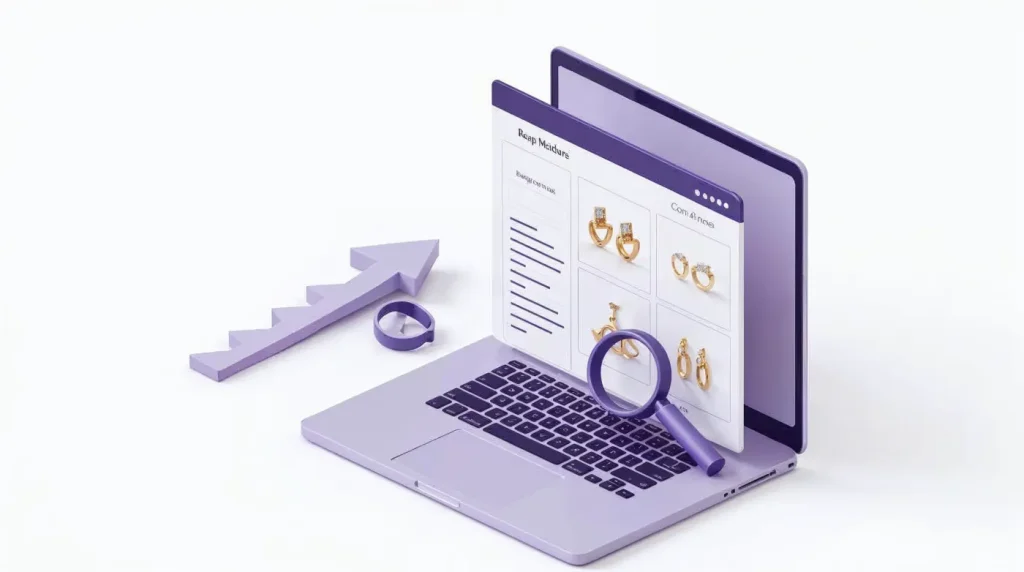
Combinations of these axes (for example, “gold earrings with diamonds”) produce a long tail of low-volume but high-converting queries. Backlinks and internal links go to the priority categories.
A practical rule of thumb: a combination earns its own indexable page only when it has stable search demand and at least a few dozen products. “Silver rings with cubic zirconia” deserves its own URL; “platinum pendants with 18 mm pearls” most likely doesn’t, so it stays a non-indexed filter.
| Page type | Role in traffic | SEO priority | Where to point links |
| Homepage | Brand and overall trust | High | Yes, branded and naked |
| Category | Main high-volume traffic | Maximum | Yes, as a priority |
| Subcategory / filter | Mid- and low-volume long tail | Medium | Selectively, to priority pages |
| Product page | Transactions for specific items | Low | Almost none |
| Holiday landing page | Seasonal peaks | Seasonal | 2–3 months before the peak |
Technical nuances: filters, duplicates and URL structure
Jewelry stores have lots of filters by metal, stone, size and price, and indexing them without control creates duplicates and cannibalization that dilute link equity. What to set up:
- open only valuable, in-demand filter combinations for indexing, and close the rest with a canonical tag or meta noindex;
- give priority filtered pages their own title, H1 and copy so they can compete for the long tail;
- remove “one product in two categories” duplicates with a canonical URL;
- keep a logical, shallow category → subcategory → product structure so important pages are 2–3 clicks from the homepage;
- watch pagination and speed: large catalogs are hard to crawl and eat up crawl budget.
A clean technical foundation saves crawl budget and keeps weak filtered pages from “eating” the traffic of priority categories.
URLs, faceted navigation and canonical tags
In its guidance on URL structure for ecommerce sites, Google recommends keeping URLs simple and stable and not letting faceted combinations turn into an endless URL space. For a jewelry store, that means /rings/gold/ is a human-readable category, while ?metal=gold&stone=cz&size=7 is a filter that shouldn’t end up in the index. If one item is available at several addresses, point to the main one with rel=canonical so Google can consolidate duplicate URL signals, including links, on a single page.
Product markup for product pages
Mark up jewelry product pages with Product structured data: name, price, currency, availability, brand and images. For stones and metals, it’s worth filling in the material property and a description of the specifications. A rich result with price and availability helps you stand out from marketplaces in the search results. For implementation details, see our article on Schema markup.
Seasonality: the demand calendar
Jewelry demand is strongly seasonal. Miss a peak, and most of the year’s revenue goes to someone else. The key waves:
- December–January: New Year and gifts;
- February 14: engagement and couples’ jewelry;
- March 8 (International Women’s Day): mass demand for gifts;
- spring–summer: wedding season, wedding rings;
- May: graduations, Mother’s Day.
Holiday landing pages are made “evergreen” (one permanent URL that gets refreshed every year) rather than creating a new address for each season, so the page accumulates link equity and history. Content and link buying for a peak need to start 2–3 months ahead, since both indexing and the effect of links are delayed. Launching a Valentine’s page on February 10 is like booking a table for the 14th that same morning: you can try, but every good spot is gone.
High order value and trust: E-E-A-T for a jewelry store
The more expensive the purchase, the more trust signals matter. For a jewelry store, these are:
- customer reviews and product ratings with real photos;
- warranties and a clear return and exchange policy;
- certificates of authenticity, hallmark and gemstone details;
- an “About us” page with the company’s history, contacts and physical locations;
- secure payment and transparent delivery terms.
These elements work for both conversion and E-E-A-T: Google treats expensive purchases as sensitive and holds such stores to higher standards of expertise and trust.
For diamonds, the strongest trust signal is an independent certificate. If a stone comes with a report from GIA (the Gemological Institute of America), list the report number on the product page and show a scan: buyers can verify the specifications themselves, and the page gets unique content that competitors selling the same item don’t have. Google’s guide to helpful, people-first content suggests asking “who, how and why” a page was created; for a jewelry store, the answer is a gemologist author on the blog, photos from your own workshop and real contact details. Read more about these requirements in our article on E-E-A-T and YMYL.
Local SEO for a physical showroom
People often want to try on wedding rings and expensive pieces in person, so a showroom in your city is a sales channel of its own. Google names three groups of Google Business Profile local ranking factors: relevance, distance and prominence. Relevance depends on accurate categories and a good profile description; prominence depends on reviews, mentions in local media and links to your site. That’s why the local link sources described below work for two channels at once.
Link building for a jewelry store: crowd links, sites and where to point them
An expensive, highly competitive niche needs a strong and natural link profile. What works best:
- crowd marketing on relevant sites, such as forums about weddings, fashion and gifts, and women’s communities: genuine recommendations fit in naturally and build trust;
- guest articles and reviews on style and gift blogs;
- local links and directories, if you have a physical store.
Why links make the difference in the jewelry niche
Google explicitly lists “Link analysis systems and PageRank” among its ranking systems, and calls PageRank one of the core systems it has used since launch. In jewelry, you feel this acutely: the top results for categories like “gold rings” or “wedding rings” are held by chains and marketplaces with years of accumulated link equity, while everyone’s copy and photos look roughly the same. After analyzing 11.8 million Google results, Backlinko found that the page in position 1 has on average 3.8 times more backlinks than pages in positions 2–10. That’s a correlation, not a guarantee, but it goes a long way toward explaining why a great category page with no links gets stuck on page two. Which, as the old joke goes, is the safest place to hide a diamond.
Building the link profile: anchors, target pages and pace
The first risk for a young jewelry store is over-optimizing commercial anchors. The natural profile of a brand people actually talk about consists mostly of the store’s name and its URLs. Here is the approximate distribution we use as a starting point:
| Anchor type | Recommended share | Examples |
| Branded | 30–40% | “Golden Ring”, “at the Golden Ring store” |
| URL / naked | 20–25% | goldenring.ua, https://goldenring.ua/wedding-rings/ |
| Generic | 15–20% | “here”, “on the store’s website”, “this catalog” |
| Partial match | 15–20% | “they have lovely diamond rings in this catalog”, “custom white gold wedding bands” |
| Exact match | 5–10% | “buy diamond rings”, “wedding rings kyiv” |
“Golden Ring” is a made-up name. The shares are a guideline, not a formula: before you start, compare them with the profiles of three to five leaders in your niche and adjust to what’s normal there. Our anchor text generator helps produce varied anchors, and the warning signs of an unbalanced profile are covered in our article on anchor text over-optimization.
Which pages get links. The homepage gets branded and URL anchors. Priority categories (wedding rings, rings, earrings, gold chains) get most of the partial- and exact-match anchors. Evergreen seasonal landing pages (“Valentine’s Day gifts”, “March 8 jewelry”) get links in waves before each peak. Product pages get links only as a natural bonus, for example when a blogger features a specific ring.
Pace. For a new store, a sensible start is 15–30 links a month with steady growth and no jumps to hundreds in a week. Seasonal links are added on top, but gradually too, over 6–8 weeks. Our link building plan tool helps you spread the volume across months.
Crowd marketing for jewelry: where and how

People love discussing jewelry, so crowd links look natural in this niche, as long as you pick the right threads. The best fits are:
- wedding forums and sections: choosing wedding bands, engagement rings, wedding budgets;
- gift threads: “what to get my wife for our anniversary”, “a gift for mom’s birthday”;
- women’s and parenting forums: jewelry for kids, first earrings after piercing, christenings;
- fashion communities: trends, mixing metals, caring for silver;
- local city forums: “where to get engraving done in Kyiv / Lviv / Dnipro”, “a reliable jeweler nearby”.
Here’s an example of a natural comment in a thread titled “Where can we order wedding rings without overpaying?”: “We bought our rings online last summer because the downtown stores were way too pricey. Tip: get your size measured at any jeweler first, it’s easy to be off by half a size using online charts. We ended up ordering here: goldenring.ua/wedding-rings/, you can filter by band width, and they did the engraving in a day.” The comment answers the question and gives useful advice regardless of the link, and it contains exactly one link, with a URL anchor, pointing to a category. You’ll find more real-world examples in our collection of crowd comment examples.
What to avoid: identical text across different threads, a link in every post from the account, exact-match anchors in comments (“buy cheap wedding rings”), self-promotion in threads where someone is asking about a different seller, and fake “reviews” posted as customers. Forum regulars spot a suspiciously happy “customer” faster than any moderator.
From our practice
When we checked 16,500 forums in October 2026, 90% were live, but only about 12% of them were in Ukrainian (around 1,819 out of 14,869, including mixed Ukrainian/Russian ones), and only 58% of forums with a visible last-post date had new posts in the previous 3 months. Even more telling: on 68% of the forums where we could check threads, the threads contained no external links at all, because moderators remove them or don’t let them through. For a jewelry store selling to Ukrainian customers, this means suitable topical sites make up just a few percent of any “database of thousands of forums”. That’s why we recommend evaluating each donor rather than chasing volume: the audience’s language, recent activity in wedding and gift sections, and whether links actually survive there. You can check a site with our donor site checker.
Among the forums that do have external links, the same check found that 49% use dofollow and 32% use nofollow or ugc. Both types are useful: nofollow links from a lively, active thread bring in buyers and keep your profile natural.
Other link sources for a jewelry store
- Lifestyle and wedding blogs: collection reviews, “how to choose an engagement ring”, metal comparisons.
- Gift guides: “what to give for March 8” round-ups in media and blogs, which feature specific items and categories.
- Local media: city news about a showroom opening, charity events or participation in fairs.
- Wedding industry partners: bridal salons, photographers and event planners recommending each other on their partner pages.
- PR around collections: a limited collection, a designer collaboration or a craftsman’s story gives people a reason to mention you, which is hard to get with ordinary content.
Seasonal link plan
Links for a holiday should appear 2–3 months before the peak so Google has time to find and count them. An approximate calendar:
| Demand peak | What to prepare and when | Links |
| New Year (December) | September: refresh the “New Year gifts” landing page and budget-based gift selections | October–November: crowd links in gift threads, gift guides |
| February 14 | November: “Valentine’s Day jewelry” landing page, couples’ and engagement rings | December–January: wedding and women’s forums, lifestyle blogs |
| March 8 | December: “March 8 gift” landing page, earring and pendant selections | January–February: “what to give my wife / mom” threads, city forums |
| Wedding season (May–September) | January–February: refresh the wedding rings category, add a size and metal guide | February–April: wedding forums, partner salons and photographers |
| Graduations, Mother’s Day (May) | February: gift landing page for graduates and moms | March–April: parenting forums, local media |
Link safety: what Google says
Google’s spam policies define link spam as creating links to or from a site primarily to manipulate rankings, and give examples such as buying or selling links for ranking purposes, excessive link exchanges and using automated programs to create links. For paid placements, Google recommends the rel=”sponsored” attribute, and rel=”ugc” for comments and forum posts. Practical takeaways for a jewelry store: don’t buy packages of hundreds of identical articles, don’t chase exact-match anchors, only publish comments that genuinely help people in the discussion, and make sure no single page receives a disproportionate share of commercial anchors. Track new links in the Links report in Search Console.
Links go primarily to priority categories and the homepage, not to individual product pages. Before buying links, it’s worth taking time to analyze competitor backlinks and assess donor trust. Our crowd marketing services and specialized jewelry store promotion help build a safe, natural profile for the jewelry niche: manual placements on live Ukrainian forums from UAH 70 per link (for orders of 100+), with a minimum order of 20 links and a report listing the URL of every placement. If the store has a physical showroom, add local SEO to the strategy and lean on the general theory from the article on what link building is.
A 90-day SEO plan for a jewelry store
- Days 1–14: technical audit covering filter indexing, canonical tags, speed, image sitemap, Product markup.
- Days 15–30: 10–15 priority categories: unique titles, H1s, copy, image alt text, internal links from the blog.
- Days 30–45: analyze the backlinks of 3–5 competitors, build an anchor plan based on the table above, shortlist live Ukrainian-language donors.
- Days 45–75: first wave of crowd links (20–40) to the homepage and categories, complete your Google Business Profile, secure the first partner mentions.
- Days 60–90: an evergreen landing page for the next seasonal peak with links pointing to it, plus a PR hook around a collection.
- Day 90: review Search Console: which links have been picked up and how category impressions have changed; adjust anchors and pace for the next quarter.
Want to get your jewelry store to the top for its categories and win orders every season? We will build a jewelry store SEO strategy for your product range, location and competition.
Sources
- Google Search Central: A guide to Google Search ranking systems
- Backlinko: We Analyzed 11.8 Million Google Search Results
- Google Search Central: Spam policies for Google web search
- Google Search Central: Qualify your outbound links to Google
- Google Search Central: Image SEO best practices
- Google Search Central: Image sitemaps
- Google Search Central: Designing a URL structure for ecommerce sites
- Google Search Central: How to specify a canonical URL
- Google Search Central: Product structured data
- Google Business Profile Help: Tips to improve your local ranking on Google
- Google Search Central: Creating helpful, reliable, people-first content
- Search Console Help: Links report
- GIA (Gemological Institute of America): diamond grading reports
- Pinterest Business